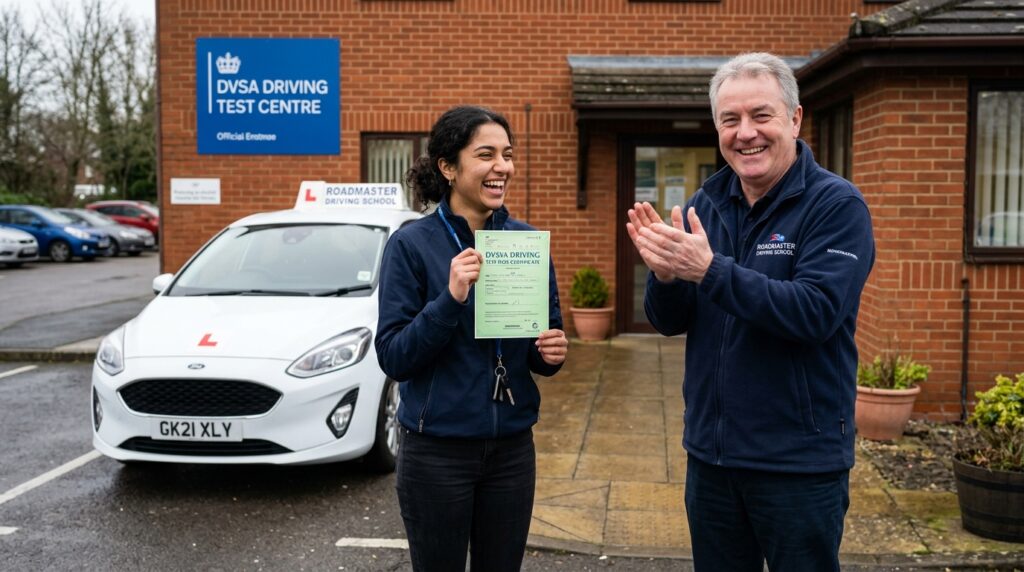
Are you tired of the thought of spending months—or even years—learning to drive with one-hour weekly lessons? You’re not alone. According to the Driver and Vehicle Standards Agency (DVSA), the average learner driver needs around 47 hours of professional tuition before they’re ready to pass their practical test. At one lesson per week, that’s nearly a full year of instruction.
But what if you could compress all that learning into just one or two weeks?
Intensive driving courses—also known as “crash courses”—are transforming how thousands of UK learners get their driving licence. Instead of spreading 45 hours of tuition across 45 weeks, intensive courses pack 5 to 7 hours of daily driving into a concentrated block, getting you test-ready in a fraction of the time.
In this comprehensive guide, we’ll cover everything you need to know about intensive driving lessons in the UK—from costs and pass rates to how to choose the right course and what to expect during your intensive week.
What Is an Intensive Driving Course?
An intensive driving course—often called a “crash course”—is a training programme that condenses months of traditional weekly driving lessons into a much shorter timeframe. Instead of taking one or two hours of lessons per week, you’ll take several hours of one-to-one tuition each day over a period of one to two weeks.
Most intensive driving courses typically last 1-2 weeks, with daily sessions of at least 5 hours (including breaks to avoid fatigue). Complete beginners usually need the full 40-50 hours of tuition spread across two weeks, while those with some prior experience may opt for shorter 5-10 hour refresher courses.
The structure is simple: you drive every day, building skills progressively without the long gaps that cause you to forget what you learned in the previous lesson. By the end of the course, you take your practical driving test—often booked in advance to align with your final day of training.
Would you like to get your driving licence via the ‘Tech-Shortcut’ without taking a test? If so, please visit our home page for full guide.
Residential vs. Local Intensive Courses
There are two main types of intensive driving courses available in the UK:
- Local intensive courses: Your instructor picks you up from your home each day, and you train on local roads. This option allows you to sleep in your own bed and maintain some normalcy during your course.
- Residential intensive courses: You stay in a hotel or B&B near the training centre, dedicating your time solely to driving lessons without daily distractions. These are particularly popular for learners who want complete immersion and are willing to travel.
Both options can get you from provisional licence holder to full licence holder in just weeks.
Why Choose Intensive Driving Lessons? The Key Benefits
1. Acquire Your Licence in Weeks, Not Months
The most obvious benefit is speed. Instead of waiting nearly a year to be test-ready, an intensive course can take you from complete beginner to licenced driver in as little as one to two weeks. This is life-changing for people who need a licence for a new job, a house move, or a major life change happening in weeks rather than months.
2. Maximised Skill Retention
When you drive for 5-7 hours per day, knowledge and muscle memory are constantly reinforced. Unlike weekly lessons where you spend the first 10-15 minutes of each session re-learning what you forgot, intensive learning means every minute counts. There’s almost no time spent on review, drastically reducing the total lessons required.
3. Higher First-Time Pass Rates
Many structured intensive courses boast higher first-time pass rates than the national average. Reputable crash course providers publish first-time rates between 55% and 70%, compared to the DVSA’s national first-time pass rate of around 47-49%. The concentrated training ensures the learner is at peak readiness on test day.
This higher pass rate means the overall cost-per-pass is often significantly lower than with weekly lessons—even though the upfront payment is larger.
4. One Consistent Instructor
With an intensive course, you typically have the same instructor throughout the entire programme. This consistency means your instructor understands your strengths, weaknesses, and learning style from day one. There’s no need to “start over” with a new instructor or explain your progress repeatedly.
5. Momentum and Confidence
When you’re learning every day, the momentum carries you. There’s no time for the doubt and procrastination that can creep in during the long gaps between weekly lessons. Many learners find that throwing themselves into an intensive schedule conquers driving anxiety faster than spreading lessons over months.
How Much Do Intensive Driving Courses Cost in 2026?
The cost of an intensive driving course varies significantly based on your location, experience level, and the number of tuition hours you need. According to the RAC, a week-long crash driving course can cost in the region of £1,000, while a two-week intensive driving course may be double that at over £2,000.
Here’s a realistic breakdown:
| Course Type | Hours | Typical Cost (2026) | Best For |
|---|---|---|---|
| Refresher | 5-10 hours | £225 – £600 | Test-ready learners or recent fails |
| Intermediate | 15-25 hours | £570 – £875 | Learners with some prior experience |
| Beginner | 35-45 hours | £1,190 – £1,440 | Complete beginners |
A typical UK intensive driving course in 2026 runs between £900 and £2,400, depending on the number of hours, your region, and whether the DVSA practical test fee is included. For a 45-hour beginner course in London, you can expect to pay around £1,500 to £1,600.
Regional Price Variations
Costs vary significantly across the UK due to instructor demand and test centre availability:
- London: 20-hour course £800-£900; 45-hour course £1,500-£1,600
- Manchester: 20-hour course £700-£750; 45-hour course £1,350-£1,450
- Birmingham: 20-hour course £720-£780; 45-hour course £1,400-£1,500
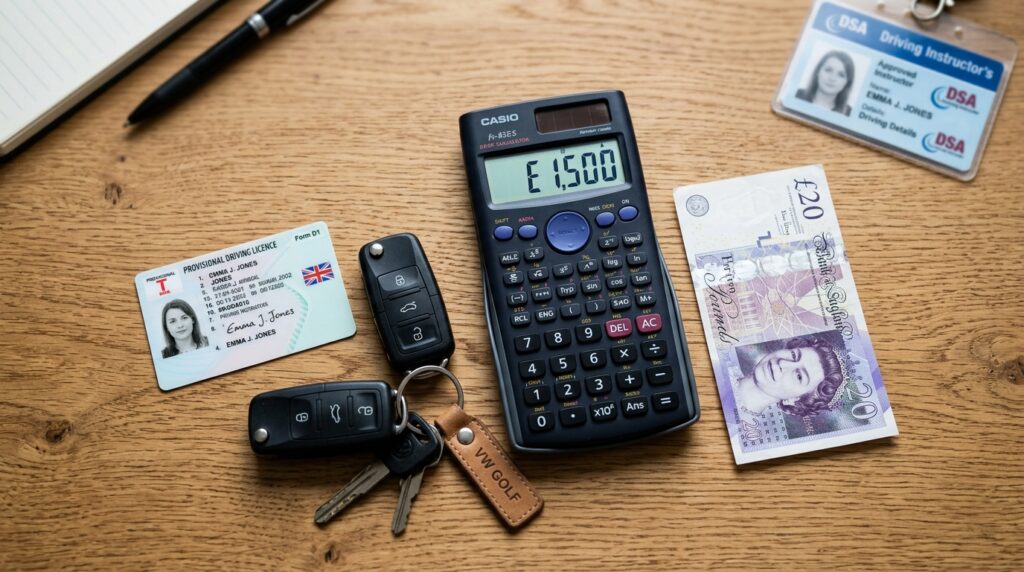
Hourly intensive rates range from £38 in the North East to £62 in Central London in 2026.
Is an Intensive Course Cheaper Than Weekly Lessons?
While the upfront cost is significant, intensive courses often work out cheaper overall. According to the RAC, the average cost of learning to drive in the UK ranges between £1,125 and £2,700. Weekly lessons typically cost between £25 and £60 per hour. At 45 hours of instruction, that’s roughly £1,125 to £2,700 spread over many months.
When you factor in that intensive students often need fewer total hours and have higher first-time pass rates (avoiding expensive retests), the cost-per-pass is frequently lower than the traditional route.
Important: Always check whether the practical test fee is included in the course price. The DVSA practical driving test costs £62 on weekdays and £75 on evenings, weekends and bank holidays.
Intensive vs. Weekly Lessons: Which Is Right for You?
Both approaches have genuine strengths—and both have drawbacks.
Weekly Lessons: The Traditional Route
Pros:
- Learning is spread out, allowing time for skills to consolidate
- The spacing effect—practising over time with gaps—supports long-term retention
- Skills become genuinely automatic through repetition over months
- Easier to fit around a busy schedule
Cons:
- Takes a long time—typically 12 to 18 months from first lesson to test day
- You spend significant time re-learning what you forgot between lessons
- Momentum is lost during gaps
Intensive Courses: The Fast Track
Pros:
- Get your licence in weeks, not months
- Skills stay fresh with daily practice
- No time to forget what you learned
- Higher first-time pass rates reported
Cons:
- Mentally and physically exhausting—driving 5-7 hours daily is intense
- Requires full availability for 1-2 weeks
- Large upfront payment
- Less exposure to varied weather and traffic conditions
The Verdict
Intensive courses are ideal for learners who:
- Need a licence quickly for work, study, or personal reasons
- Can commit fully to 1-2 weeks of intensive training
- Thrive under pressure and maintain focus during long sessions
- Have some prior driving experience (10-20 hours is ideal)
Weekly lessons are better for learners who:
- Prefer a gradual, low-pressure approach
- Have a busy schedule that can’t accommodate full-time training
- Need more time for skills to consolidate
- Are on a tighter budget that can’t stretch to a large upfront payment
What to Expect During Your Intensive Driving Course
A Typical Daily Schedule
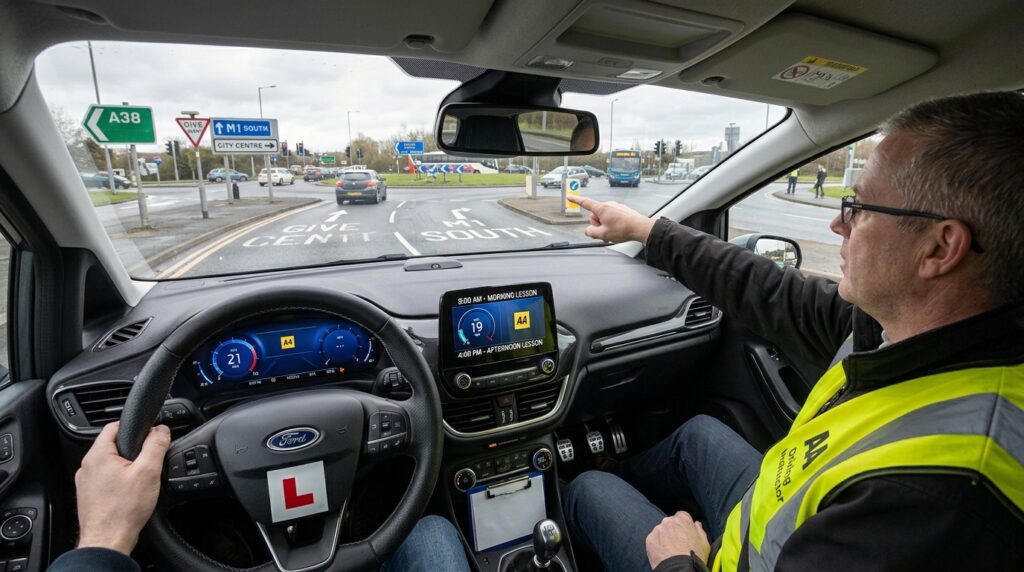
Most intensive courses run for 4-6 hours of driving per day, with regular breaks to prevent fatigue. A typical day might look like:
- Morning session (2-3 hours): Core driving skills, junctions, and roundabouts
- Break: Rest, review, and refresh
- Afternoon session (2-3 hours): Manoeuvres, parking, and route practice
- End-of-day debrief: Progress review and next-day planning
Course Progression
The training follows a clear progression:
- Early lessons: Building core driving ability—car control, clutch (for manual), steering, and road awareness
- Mid-course: Introducing more challenging scenarios—multi-lane roads, roundabouts, heavy traffic, and complex junctions
- Later lessons: Shifting toward practical test preparation—mock tests, test routes, and exam conditions
- Final day: Practical driving test (if booked as part of the course)
Mock Tests
Most quality intensive courses include mock driving tests as part of the programme. These are invaluable because they help you manage nerves and understand exactly what examiners expect. By the time the real test arrives, the experience feels familiar rather than overwhelming.
How to Choose the Right Intensive Driving Course
Not all intensive courses are equal. Here’s what to look for—and what to avoid:
1. Check the Instructor Is a Fully Qualified ADI
Ensure your instructor is a DVSA Approved Driving Instructor (ADI). The DVSA has issued fresh guidance telling learner drivers to ensure their instructor is officially approved—amid concerns some may be paying for lessons with unqualified teachers.
You can find DVSA approved driving instructors by visiting GOV.UK and using the official “find driving instructors” service. Simply enter your postcode to find approved driving instructors near you.
The official search tool is available at: https://finddrivinginstructor.dvsa.gov.uk
DVSA-registered instructors follow official standards and are regularly assessed to maintain their qualification. You can also view DVSA’s official register data, which is updated quarterly.
2. Make Sure the Course Length Suits Your Experience
Complete beginners usually need 40-50 hours of tuition. If you already have some experience—perhaps you’ve had 10-20 hours of previous lessons or practiced with family—you may only need 20-30 hours.
Always ask the provider for a professional assessment lesson before committing. This ensures you book the right course length and don’t waste money on hours you don’t need.
3. Read Reviews and Check Pass Rates
Look for courses with good reviews and transparent pass rate data. Be wary of schools with multiple poor reviews or complaints about hidden fees.
4. Check What’s Included
Always clarify what’s included in the price:
- Does it include the DVSA practical test fee (£62-£75)?
- Are mock tests included?
- Is there a fast-track test booking service?
- What happens if you’re not ready by the test date?
5. Manual vs. Automatic
You’ll need to decide whether to learn in a manual or automatic vehicle.
- Manual: Allows you to drive both manual and automatic cars. Manual cars are often cheaper to purchase and run.
- Automatic: Easier and faster to learn—automatic learners average 30-35 hours vs. 45+ hours for manual. However, an automatic licence restricts you to automatic vehicles only.
Automatic lessons typically cost £2-£5 more per hour than manual due to higher vehicle and maintenance costs.
UK Driving Test Waiting Times: Why Intensive Courses Make Sense Now
One of the biggest challenges facing UK learner drivers in 2026 is driving test waiting times.
According to figures provided to the BBC by the DVSA for April 2026:
- England: 22.7 weeks average wait
- Scotland: 22.9 weeks average wait
- Wales: 17.3 weeks average wait
The DVSA initially had a target of reducing the average waiting time to seven weeks by the end of 2025, but this was pushed back to summer 2026 and then further delayed. As of May 2026, the average waiting time stood at 22 weeks—more than five months.
The BBC has repeatedly heard from learner drivers frustrated by the difficulty of booking tests when, and where, they need them. Some have ended up buying slots from resellers who charge many times the official cost.
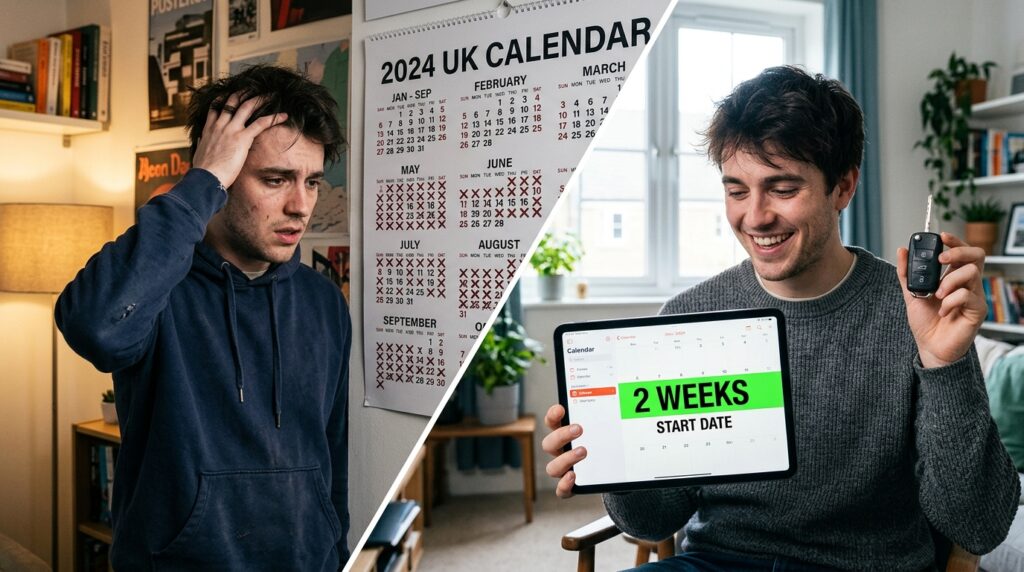
This is where intensive driving courses offer a critical advantage: reputable providers have fast-track test booking services that secure test dates aligned with the end of your course. Instead of waiting 22 weeks for a test, your course provider can often book a slot that matches your training completion date.
Important: Always check that your chosen provider genuinely offers fast-track test booking and doesn’t just promise it. Some companies have been criticised for taking payments without securing test dates.
Success Stories: Real Learners Who Passed Fast
Thousands of UK learners have successfully obtained their driving licence through intensive courses. Here are just a few examples:
Liv from Stogursey passed her driving test first time with zero faults after completing a two-week intensive course.
Marcus took a 40-hour intensive course over two weeks, dedicating himself completely to learning. He passed with just five minors and started his new job the following Monday.
One learner who completed a 20-hour intensive course shared: “Absolutely brilliant service! My instructor Sarah was patient and professional. Passed first time thanks to the intensive course. Highly recommend to anyone looking to get their licence quickly”.
These success stories demonstrate that with the right course, the right instructor, and the right mindset, obtaining your UK driving licence in weeks is absolutely achievable.
Essential Tips for Passing Your Intensive Driving Course
To maximise your chances of passing first time, follow these expert tips:
Before the Course
- Pass your theory test first. Most reputable intensive schools will not accept students without a theory pass certificate. The theory test costs £23 and must be done before your practical training. You can book your driving theory test on the GOV.UK website.
- Get your provisional licence. You need a valid UK provisional driving licence to take any driving course. You can apply online from age 15 years and 9 months via the official application service.
- Read the Highway Code before your course starts. Familiarity with the rules of the road gives you a head start.
- Get some private practice if possible. Learners who’ve had even informal practice with family tend to perform better on intensive courses. If practising in your own car, you’ll need learner driver insurance.
During the Course
- Get plenty of sleep each night. Driving is mentally exhausting, and you need to be sharp every day.
- Stay hydrated and eat well. Proper nutrition and hydration support concentration.
- Communicate with your instructor. Tell them about any areas you’re struggling with—they’re there to help.
- Treat it like a job, not a holiday. Learners who treat intensive courses seriously consistently outperform those who don’t.
- Take breaks seriously. The breaks between driving sessions aren’t optional—they’re essential for preventing fatigue and maintaining concentration.
Frequently Asked Questions
Can I pass my driving test in one week?
Yes, it’s possible—but it depends on your experience level. A one-week intensive course typically packs 25 to 35 hours into five days. This is enough for many learners, particularly those with some prior experience. Complete beginners usually need the full 40-50 hours spread across two weeks.
Is there a legal minimum number of driving lessons?
No. There is no legal minimum number of lessons required before taking your practical test in the UK. However, the DVSA recommends an average of 45 hours of professional tuition plus 22 hours of private practice.
What if I fail my test?
If you fail, most intensive course providers offer additional lessons and support for rebooking your test. The DVSA practical driving test costs £62-£75 each time.
Do I need to have passed my theory test before booking?
Yes. Most providers will not allow you to book until you’ve passed your theory test. The theory cannot be done alongside practical training.
Are intensive driving courses worth it?
For the right learner, absolutely. They offer speed, higher pass rates, and often lower overall cost-per-pass than weekly lessons. However, they require full commitment, a significant upfront payment, and the ability to handle intense daily practice.
Final Thoughts
Intensive driving lessons in the UK offer a genuine fast-track to obtaining your driving licence in just a few weeks. While they’re not for everyone—they demand commitment, focus, and a significant upfront investment—for the right learner, they can be transformative.
With current DVSA test waiting times stretching to over 22 weeks in many parts of the UK, the ability to complete your training and take your test within a concentrated period is more valuable than ever.
If you’re ready to commit, do your research, choose a reputable provider with DVSA-approved instructors, and prepare yourself mentally for an intense but rewarding week or two behind the wheel. Your full UK driving licence could be closer than you think.
You can now find a comprehensive guide on our blog with tips on how to avoid getting points on your UK driving licence. Why not have a look, enjoy your journeys and stay safe on UK roads.