Your go-to resource for understanding UK parking fines, knowing your rights, and staying ahead of the UK’s most controversial parking changes
Let’s face it: there are few things more frustrating than returning to your car only to find that dreaded yellow envelope tucked under your windscreen wiper. In 2026, parking fines in the UK remain one of the most common headaches for motorists, with record numbers of tickets being issued and controversial new fine structures sparking national debate.
This comprehensive guide covers everything you need to know about parking fines in 2026—from current penalty rates and your appeal rights to the heated controversy over £160 fines and the recent motorway parking scandal that has drivers up in arms.
Understanding the Different Types of Parking Fines
Not all tickets are created equal. In the UK, the rules and your rights to appeal depend entirely on who issued the notice. As of 2026, there are three primary categories:
1. Penalty Charge Notices (PCNs)
These are issued by local councils or Transport for London (TfL) for parking on public land, such as high streets or council-run car parks. Civil Enforcement Officers (CEOs) enforce these civil matters.
2. Fixed Penalty Notices (FPNs)
Issued by the police for more serious offences, such as parking in a way that obstructs the road or creates danger to others. Unlike a PCN, an FPN is an offer to settle without going to court—but if ignored, it can lead to prosecution and a criminal record. “AA guide to Fixed Penalty Notices and motorway offences“.
3. Parking Charge Notices
Despite the similar name, these are issued by private companies (like those managing supermarket or hospital car parks). These are technically invoices for a perceived breach of contract. As of 2026, these are strictly governed by the Private Parking Code of Practice, which has introduced a single, government-sanctioned appeals service.
Current 2026 Parking Fine Rates and Penalties
The cost of parking fines has seen significant adjustments in 2026 to keep pace with inflation and urban management goals:
London
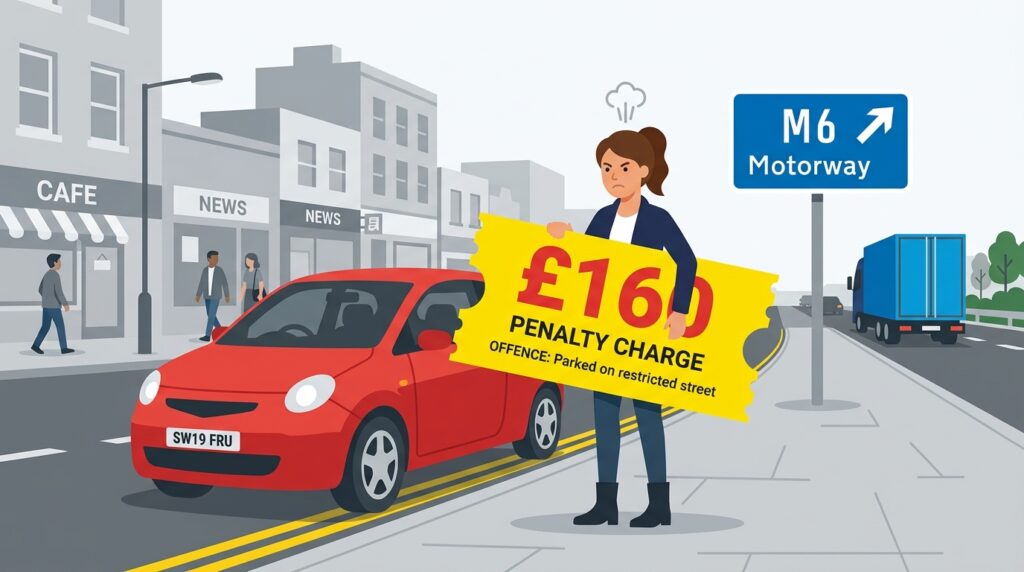
- Higher-level contraventions (like parking on double yellow lines): capped at £160
- Lower-level offences (like overstaying in a bay): £80 (rates vary by borough—check local council websites for specific tiers)
Outside London
Both rates are reduced by 50% if you pay within 14 days of the date of issue.
Private Land
Under the Private Parking Code of Practice, private charges are generally capped at £100, though this is reduced to £50 in most areas if paid promptly. “Government’s Private Parking Code of Practice (2026)”
The 14-Day Discount Rule
In almost all cases involving a council PCN, if you pay within 14 days, the fine is reduced by 50%. This remains the most common way motorists settle their debts quickly.
The 10-Minute Grace Period: Your Rights in 2026
One of the most important protections for UK drivers is the statutory 10-minute grace period. According to the Deregulation Act 2015 and the 2026 Private Parking Code of Practice, both local authorities and private parking operators must allow you 10 minutes of leeway after your paid parking time expires or after a free parking period ends in a designated bay.
If you’re issued a ticket at 2:09 PM for a ticket that expired at 2:00 PM in a legal bay, you have a very strong case for an immediate challenge.
The £160 Fine Controversy: Labour’s “Crazy” Proposal
The Bournemouth Trial
In a move that has sparked fierce national debate, a month-long trial in Bournemouth last summer hiked maximum parking fines to £160—more than double the existing £70 cap outside London.
The scheme, run by Bournemouth, Christchurch and Poole (BCP) Council along a seven-mile coastal stretch with 29 car parks and 543 roads, saw thousands of drivers handed PCNs of £160, dropping to £110 for smaller offences. The fines were halved if paid within a fortnight.
Government Response
Ministers have admitted they are “looking into” and “carefully considering” the findings of this trial. Transport Minister Simon Lightwood confirmed the Department for Transport is “reviewing the findings” of the trial.
The Backlash
The proposals have been met with fierce opposition:
- Shadow Transport Secretary Richard Holden warned the plans amounted to “fleecing” motorists, saying: “This is entirely about raising revenue and raiding drivers”
- Reform UK deputy leader Richard Tice dubbed it “yet another tax on working Britain”
- Edmund King, president of the AA, slammed the idea as “crazy”, noting it would hike penalties above those handed to shoplifters and vandals
The Counter-Argument
BCP Council defended the change, saying it “made roads safer, reduced congestion and improved accessibility” and demonstrated that “higher PCN levels can effectively improve compliance”. The Local Government Association supports the Government’s intention to review the cap, noting: “Fines outside London have remained the same since 2008. In many places, this can serve as a less effective deterrent to unfair, inconsiderate and illegal parking”.
The Motorway Parking Controversy: Hard Shoulder Breaks Spark Outrage
The M6 Incident That Shocked the Nation
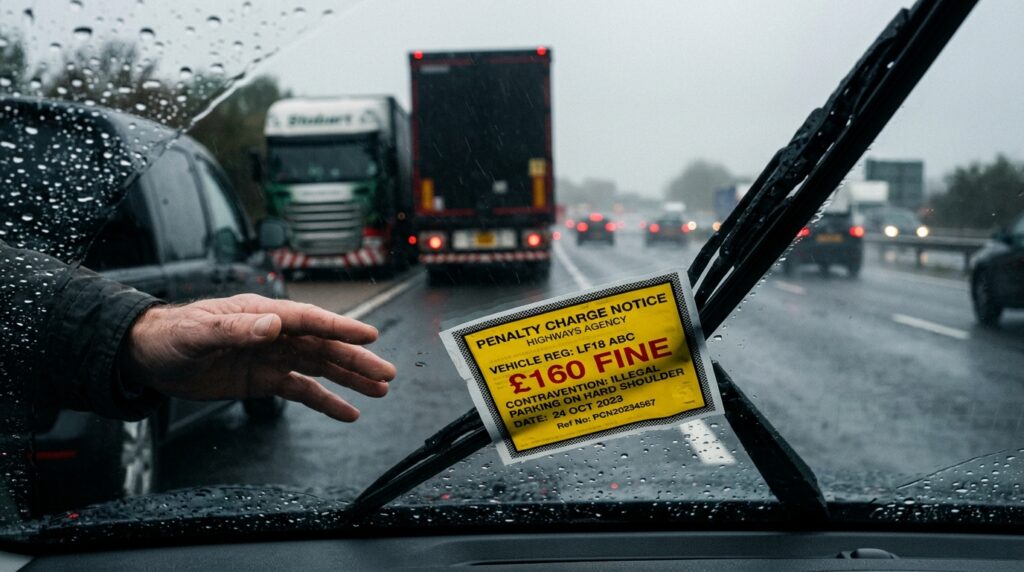
In a recent incident that has reignited debate about motorway safety, a lorry driver was caught by Staffordshire Police taking a tachograph break on the hard shoulder of the M6.
The driver was taking a mandatory 45-minute rest period required for every four-and-a-half hours of driving—but took it parked on the hard shoulder rather than at a safe, legal stopping point.
What the Law Says “Penalty Charge Notice regulations (legislation.gov.uk)”
A Staffordshire Police spokesperson made the position crystal clear: “Parking on the hard shoulder is only acceptable in emergency. Unfortunately taking a tachograph break is not classed as an emergency and carries points and a fine”.
The Penalties
- £100 fine for driving on or parking on the hard shoulder
- Three penalty points on your licence
- Potential for higher penalties in serious cases
Highway Code Rule 240
Rule 240 of the Highway Code explicitly states that you must never stop or park on:
- The carriageway
- An emergency area
- A hard shoulder of a motorway except in an emergency
“Highway Code Rule 240—hard shoulder parking rules“
The Controversy
This incident has sparked widespread debate about driver safety and the availability of adequate rest facilities for HGV drivers. Critics argue that:
- Insufficient rest stops force drivers into desperate measures
- Tachograph regulations are rigid and don’t account for real-world conditions
- Safety is compromised when drivers feel pressured to keep driving rather than stop
Police have reminded drivers: “When planning your route please take into account your scheduled breaks and safe, legal places these can be taken”.
Private Parking: The “Epidemic” of Fines
Record-Breaking Numbers
Private parking firms issued a record 14.4 million tickets to drivers over the 12 months ending March 2025—more than double the number six years ago.
Even more concerning, by September 2025, that figure had climbed to 15.9 million, up 17% from the previous year. That’s approximately 48,000 tickets per day.
Each private parking ticket averages around £100, meaning motorists across the UK are being charged approximately £4.8 million per day.
“Parking (Code of Practice) Act 2019—Hansard“
The RAC’s Warning
RAC head of policy Simon Williams expressed serious concern: “While part of the rise may be due to more car parks being privately managed, the figures show that 48,000 tickets per day were issued… which seems ominously high, considering most people try very hard to avoid receiving a private parking notice”.
He added: “This is why we fear something must be going badly awry”. “RAC advice on parking fines and PCNs“
Why So Many?
The Private Parking Code of Practice—which was intended to clamp down on rogue operators—was withdrawn in 2022 following legal challenges from private parking and debt recovery companies. This has meant the behaviour of private parking companies has not been scrutinised as intended.
Faulty Machines Adding to the Problem
Campaigners have warned that thousands of drivers across England are being sent demands for up to £170 from private parking companies because of faulty machines. More than 41,000 parking charge notices are being sent to drivers in Britain by private companies every single day.
How to Appeal a Parking Fine: Step-by-Step Guide
“Traffic Penalty Tribunal—appeal your PCN“
If you believe a parking fine has been issued incorrectly, you have rights. Here’s what to do:
Step 1: Identify the Issuer
Check the ticket to find out who issued it. Is it a council (PCN), police (FPN), or private company (Parking Charge Notice)?
Step 2: Act Quickly
You typically have 28 days from the date of issue to challenge or appeal.
Step 3: Gather Your Evidence
Collect everything that supports your case:
- Photos of unclear or misleading signage
- Pay-and-display tickets
- Witness statements
- Evidence of faulty payment machines
Step 4: Submit Your Challenge
- Council PCNs: Use the council’s online appeal form—this typically takes about 15 minutes to complete
- Private Parking: Contact the operator directly or use the official appeals service
Step 5: Escalate If Necessary
If your challenge is rejected:
- Council PCNs: You can appeal to the Traffic Penalty Tribunal (www.tpt.gov.uk)[reference:55]
- Private Parking: Appeal to the independent appeals service (check if the operator is a member of an accredited trade association)
Valid Appeal Grounds
Your appeal is likely to be considered if there were:
- Mitigating circumstances (e.g., medical emergency)
- Faulty parking machines
- Unclear or misleading signage
- The 10-minute grace period was not honoured
- You were not the driver at the time
Key Tips to Avoid Parking Fines in 2026
- Know your grace period—you have 10 minutes after your ticket expires
- Check signage carefully—unclear signage is a valid appeal ground
- Always display your ticket correctly—parked without clearly displaying a valid pay and display ticket is a £50 offence
- Never park on double yellow lines during restricted hours—this is a £70 offence
- Plan your breaks on motorways—hard shoulder parking is for emergencies only
- Pay within 14 days to get the 50% discount on council PCNs
- Never ignore a ticket—the penalties will only increase, and you may lose your right to appeal
- Park correctly within bay markings—not parking correctly within the markings is a £50 offence
The Future: What’s Coming Next?
Potential Nationwide £160 Fines
The government is “carefully considering” rolling out the Bournemouth £160 fine model across England.
Pavement Parking Crackdown
Pavement parking is already illegal in London, with drivers slapped with £160 penalties if caught. Labour MPs have welcomed this move, saying it helps protect children and disabled people who rely on “accessible pavements”.
Private Parking Reform
The government is under pressure to finally implement the Private Parking Code of Practice with all the protections it was intended to have.
Petition for Change
A parliamentary petition calling for a review of private parking regulation has been launched, arguing: “Drivers are being punished by confusing signage, tiny unreadable print and zero grace time”.
Final Thoughts
Parking fines in the UK are at an all-time high—both in terms of numbers issued and the potential penalties involved. The controversial £160 fine proposals and the motorway parking scandal have highlighted just how contentious this issue has become.
Your best defence is knowledge. Understand your rights, know the rules, and never be afraid to challenge a ticket you believe was issued unfairly. The 10-minute grace period, clear signage requirements, and proper appeal processes exist to protect you—use them.
Remember: if you receive a parking fine in 2026, act quickly, gather your evidence, and don’t hesitate to appeal if you have a valid case. With fines rising and enforcement tightening, staying informed has never been more important.
You can find the latest information and further details on driving in the UK, fines, penalty points and extending your driving licence on our blog – where you’ll find the most up-to-date and easy-to-understand information.